







You see 10,000 mAh on the packaging of a power bank, but in practice it does not charge your phone twice? That is completely normal. The stated capacity of a power bank is not the same as the energy your phone actually receives. The difference is mainly caused by voltage conversion and losses during charging.
So if you choose a power bank only by the mAh number, your expectations of the product may differ from reality. In this article, we will explain why the real capacity is lower, how to calculate it approximately, and what to look for when choosing a power bank so that it truly makes sense for everyday use.
What does the capacity of a PowerBank in mAh mean?
The capacity of a power bank is most commonly stated in mAh, or milliampere-hours. However, this number is based on the capacity of the internal battery cells inside the power bank, which usually operate at a nominal voltage of around 3.7 V. When the power bank charges a phone, the energy is converted to a USB output, which typically operates at 5 V or even higher voltage with fast charging. This conversion is where part of the difference between the stated and actually usable capacity occurs.
In other words: the figure 10,000 mAh is neither a lie nor a marketing trick. It is a technical specification; you just need to understand what it refers to.
Why is the real capacity of a Power Bank lower?
There are basically three reasons.
1. Conversion from 3.7 V to 5 V
The internal cells of a power bank store energy at a different voltage than the one used to charge your phone. When the capacity is recalculated from 3.7 V to 5 V, the resulting mAh figure decreases. This is why a 10,000 mAh power bank does not deliver the “full” 10,000 mAh to your phone through the USB output.
2. Losses in the electronics
Energy losses occur in the power bank’s control electronics during conversion. Not all the energy stored in the power bank therefore reaches the connected device. As a rough estimate, you can count on an efficiency of around 85–90%.
3. Losses during phone charging itself
Another part of the energy is lost in the cable, in the phone’s charging circuit, and also due to temperature or the condition of the device’s battery. As a result, the final figure is never completely precise and may vary from model to model in practice.
How can you roughly calculate the real capacity?
A simple approximate conversion:
For a power bank with a capacity of 10,000 mAh, this conversion gives approximately:
However, this is still not the final practically usable value, because you also need to account for losses. For example, if you use an approximate efficiency of around 85%, you get 6,290 mAh (7,400 * 0.85) of realistically usable capacity.
That is why it is completely normal that a 10,000 mAh power bank will not charge a phone with a 5,000 mAh battery twice to 100%.
Quick guide by use:
If you mainly want a power bank as a pocket-sized backup, look at 5,000 mAh models. For a typical day, 10,000 mAh is the most practical choice. For weekends, travelling, or multiple devices, 20,000 mAh or more makes sense.

How many times will a power bank charge a phone in practice?
That depends on several factors:
- the actually usable capacity of the power bank
- the size of the phone battery
- charging efficiency
- the condition of the phone battery
- whether you are using the phone while it is charging.
That is why it is always better to view capacity as an approximate energy reserve, not as an exact number of future charges.
Is it better to look at mAh or Wh?
For more accurate comparison, it is better to look at Wh, or watt-hours, because this expresses the actual amount of energy without distortion caused by different voltages. When comparing power banks, we recommend focusing more on Wh than on mAh alone if you want the most accurate idea of how much energy the device can actually store.
However, most customers usually choose according to mAh because it is an easier specification to understand. That is perfectly fine; it is just good to know that two power banks with the same mAh number may not perform exactly the same in practice if they differ in efficiency, outputs, construction, or charging method.
What Power Bank capacity should you choose?
Your choice should mainly depend on how you use the power bank.
5,000 mAh: emergency top-up during the day
A smaller capacity is suitable if you want a lightweight power bank for your pocket or handbag and mainly need a backup for the journey home, meetings, or an evening top-up.
10,000 mAh: the ideal compromise for most people
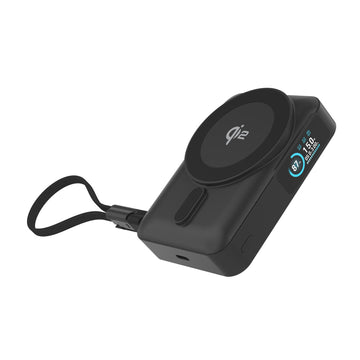
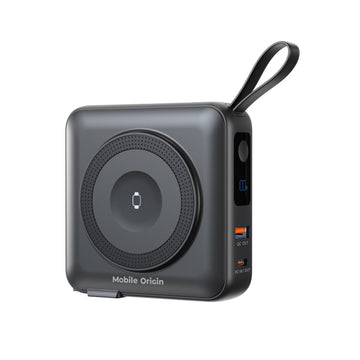
This capacity is usually the most practical for everyday use. The power bank is still easy to carry, while providing a reasonable reserve for travelling, longer days away from the office, or trips. In this category, Mobile Origin offers several 10,000 mAh models, including compact MagSafe-compatible options and travel solutions with integrated cables.
20,000 mAh and more: longer trips and multiple devices
A higher capacity makes sense for weekend travel, active use of navigation, photography, working on the go, or when you want to charge several devices at once. The downside is usually larger dimensions and higher weight.
What should you look at besides capacity?
Capacity is important, but on its own it is not enough. When choosing a power bank, it is worth considering other parameters as well.
Fast charging
Look for support for technologies such as Power Delivery or output power in watts. A power bank with higher power can charge a phone faster, and for some devices this is just as important in practice as the capacity itself. For example, selected Mobile Origin models offer 20W Power Delivery via USB-C.
Type and number of outputs
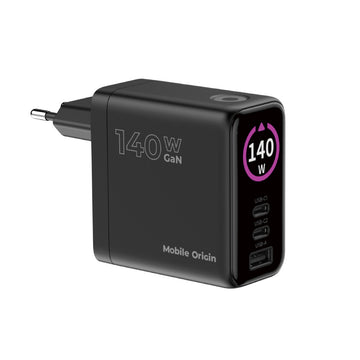
Some users only need one USB-C port, while others will appreciate integrated cables or the option to charge multiple devices. If you travel often, a solution that combines a power bank and travel charger in one is very practical.
Wireless charging and MagSafe
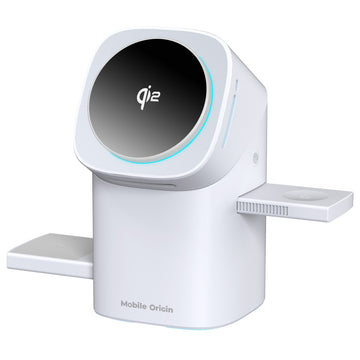
If you use an iPhone and want the most convenient experience, a magnetic wireless power bank may make sense. However, you need to take into account that wireless charging is usually less efficient than charging by cable, which can mean higher energy losses. Mobile Origin also offers models with MagSafe and wireless charging.
Size and portability
A large capacity is great only until you stop carrying the power bank with you because it is too heavy or impractical. For everyday use, the best choice is often a sensible compromise between capacity and size.
Safety and build quality
With a power bank, it is also worth looking at build quality, safety protections, and practicality in everyday use. These are often the features that determine whether you will actually carry the power bank with you every day.
What does real capacity mean when choosing a Mobile Origin power bank?
When choosing a power bank, it is not just about getting the highest possible mAh number. What matters more is whether you will actually carry it, how quickly it charges, and whether it has features you will use every day.
So if you are choosing a power bank for everyday carrying, a well-made 10,000 mAh model with fast charging and practical features often makes more sense than a heavier option with a higher capacity that you end up leaving at home.
Summary: what is the real capacity of a power bank?
The real capacity of a power bank is always lower than the number stated on the packaging, because the stated mAh is based on the internal cells at a different voltage, and energy is lost during charging. With power banks, it therefore makes sense to expect the practically usable capacity to be lower.
When choosing one, look not only at capacity, but also at power output, charging type, practicality, and overall build quality. It is precisely the combination of these parameters that determines whether the power bank will work well in real everyday use.
FAQ
Is it normal that a 10,000 mAh power bank does not charge a phone twice?
Yes. The stated capacity refers to the internal cells at a different voltage, and part of the energy is lost during conversion and charging.
Does lower real capacity mean the power bank is poor quality?
Not necessarily. The difference between stated and usable capacity is a normal physical phenomenon. Quality is better judged by efficiency, safety, charging speed, and overall build quality.
Is it better to choose a power bank by mAh or Wh?
For more accurate comparison, Wh is better because it more clearly expresses the actual amount of energy. For general orientation, however, mAh is enough for most people.
Is more energy lost during wireless charging?
Usually yes. Wireless charging is generally less efficient than cable charging, so the realistically usable energy may be lower.
What capacity is best for a typical day?
For most users, 10,000 mAh is the most practical choice because it offers a good balance between capacity, size, and convenient portability. At Mobile Origin, we have several models in this category designed for everyday use.