







„9H hardness" is one of the most common claims on screen protector packaging. Most people instinctively read it as near-diamond toughness. In reality, it comes from a completely different test than most assume.
What the pencil hardness test actually is
9H does not come from the Mohs mineral hardness scale. It comes from an industrial test originally developed for paints and surface coatings: graphite pencils of varying hardness grades are drawn across the surface at a 45° angle under constant pressure. If the surface resists the hardest standard pencil in the set — the one marked 9H — the product earns that rating. The test is described in ASTM D3363, a standard first published in 1974 and last revised in 2022. Its European equivalent is ISO 15184.
The confusion that became a myth
The Mohs scale measures which minerals can scratch others: diamond sits at 10, corundum (sapphire) at 9, quartz at 7, and ordinary glass around 5–6. Tempered glass used in screen protectors typically reaches 6–7 on the Mohs scale. The hardest pencil in the test set (9H) corresponds to roughly 3 Mohs — about the same as a human fingernail. The two scales are unrelated, but their notation looks identical, and that is the root of the confusion.
The practical consequence: quartz found in sand and dust rates 7 Mohs, meaning it can scratch even a „9H" glass. Brass and steel keys rate approximately 3–4.5 Mohs — lower than tempered glass, so under normal conditions they will not scratch it.
|
Mýtus / Myth „9H means the same as Mohs 9 — the glass is almost as hard as a diamond." |
Skutečnost / Fact 9H is the maximum of the pencil scale, corresponding to roughly 3 Mohs. Sand and dust (7 Mohs) can still scratch the glass. |
What about „10H", „12H", and similar claims?
The standard pencil hardness scale ends at 9H. Ratings like „10H" or „12H" have no basis in any standardised norm and cannot be verified by any established methodology. They are purely marketing terms.
Marketing warning
Claims of „10H", „12H", or „Super 9H" are non-standardised. No recognised norm exists for these values — the pencil hardness scale simply does not go above 9H.
Hardness ≠ shatter resistance
9H describes surface scratch resistance only. It says nothing about drop resistance, impact absorption, or edge strength. A very hard glass can still be brittle under impact — these are entirely separate parameters.
What actually matters
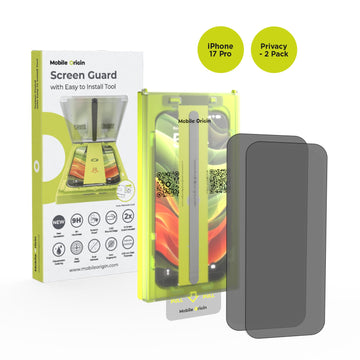
Mobile Origin Screen Guard and EasyGlass protectors undergo a steel wool test at 10,000 passes — steel wool sits at 5–6 Mohs, making this a significantly more demanding standard than the pencil test. Beyond surface hardness, what determines real-world protection is the oleophobic coating (fingerprint resistance), adhesive quality and type, the PET layer (which holds fragments together if the glass breaks, similar to safety film), impact absorption, and precise display coverage. A spare glass included in the pack addresses the practical reality: no protective layer lasts forever.
Conclusion
9H is a valid baseline — but only one quality indicator, not a guarantee of absolute protection. Real-world performance depends on the combination of layers, precise fit, and edge strength.